

A buy-to-let stress test is the calculation a lender runs to decide how much it will lend against the rent, and on most deals it sets the ceiling before the property value or the size of your deposit does. The rate it tests at is not the rate you pay, and it follows the wholesale cost of fixed-rate money rather than Bank Rate, so the same rent can support a noticeably smaller loan a few months later while the Bank of England has not moved at all.
The arithmetic is simple, but it is rarely shown, which is why most landlords only find out where the line sits when an offer comes back lower than they expected.
How the stress test works
The test has two parts. The interest cover ratio (ICR) is how far the rent must exceed the mortgage interest, written as a percentage: at 125%, the rent has to be at least a quarter higher than the interest. The stress rate is the interest rate the lender assumes when it does that sum, and it is set above the product rate on purpose, so there is headroom if costs rise during the loan.
The floor comes from the Prudential Regulation Authority (PRA), which supervises the larger lenders, in its supervisory statement on buy-to-let underwriting. Since 2017 lenders have been expected to test at the product rate plus two percentage points or 5.5%, whichever is higher, over at least the first five years of the loan. The exception is a fixed rate of five years or longer, where the lender may test at the rate you will actually pay, because the payment is known for the whole period the test covers.
Lenders build on that floor rather than sitting on it, and this is where the differences start. A common pattern is 125% for basic-rate taxpayers and limited companies and 145% for higher-rate taxpayers. The reason is tax: since the finance cost restriction came in, a landlord holding property in their own name is taxed on the rent rather than the profit, so the same rent leaves a higher-rate taxpayer less to service the loan. Some lenders use one ratio for everyone, some use 140% or 160% for certain property types, and specialist lenders set their own stress rates above or below the PRA floor depending on the product.
The stress rate is a test assumption and nothing more. You are never quoted or charged it. It exists only to answer one question: would the rent still cover the interest if borrowing costs were higher than they are today?
A worked example: same property, different product
Take two landlords who each own a £285,000 property through a limited company, let at £1,200 a month, which is £14,400 a year. Both are tested at an ICR of 125%, the usual figure for a limited company. The only difference is the product they choose, and with it the stress rate the lender applies. The maximum loan is the annual rent divided by the stress rate multiplied by the ICR.
Landlord A takes a five-year fixed rate, and the lender tests it at 5.5%. That gives £14,400 divided by 0.06875, which is about £209,500, or a loan to value of roughly 73.5%.
Landlord B takes a two-year fixed rate. Two-year products are tested at the product rate plus two points, and here that comes out at 7.5%. The same £14,400 is now divided by 0.09375, and the maximum loan falls to £153,600, a loan to value of about 54%.
| Landlord A | Landlord B | |
| Property value | £285,000 | £285,000 |
| Rent | £1,200 a month | £1,200 a month |
| Product | Five-year fixed | Two-year fixed |
| Stress rate | 5.5% | 7.5% |
| ICR | 125% | 125% |
| Illustrative maximum loan | About £209,500 | £153,600 |
| Loan to value | About 73.5% | About 54% |
Same property, same rent, same company, and roughly £55,900 between what each can borrow. Neither lender has done anything unusual. Landlord B has picked a product the rules require to be tested harder. These figures are illustrative only, and actual borrowing depends on lender criteria, mortgage terms and individual circumstances.
If Landlord B needs the larger loan, the options are the five-year product with its longer tie-in and early repayment charges, a bigger deposit, or a property where the rent is higher relative to the price. Which of those makes sense depends on the numbers. Sometimes the honest answer is that the property does not work as a buy-to-let at that price, however nice it is.
Why the test moves when Bank Rate doesn’t
Fixed-rate mortgage pricing follows swap rates, which are the wholesale cost to a lender of fixing its funding for two or five years, anFixed-rate mortgages are priced off swap rates, not Bank Rate. A swap rate is the wholesale cost to a lender of fixing its own funding for a set period, two or five years for example. It reflects where markets expect interest rates to average over that period, so it moves every day with inflation data, government borrowing and events abroad, while Bank Rate changes only at the Bank of England’s scheduled meetings.
When swap rates rise for long enough, lenders reprice their fixed products upward to protect their margins. On a two-year fix the stress rate is the product rate plus two points, so a higher product rate becomes a higher stress rate. On a five-year fix tested at the pay rate, the same rise feeds into the test directly.
There is one cushion. While pricing is low enough that the product rate plus two points sits under 5.5%, the floor applies and small moves change nothing. Once pricing climbs above that line, every quarter point on the product rate is a quarter point on the stress rate. On Landlord B’s numbers, each quarter point added to the stress rate takes roughly £5,000 off the maximum loan.
That is why a landlord waiting for a Bank Rate cut to loosen the test can be watching the wrong number. Bank Rate can sit still for months while the cost of fixed money, and with it the stress test, moves on its own timetable.
How far swap rates have moved in 2026
This is the one section of this guide that dates. The figures are month-end rates to 30 October 2026, and nothing else in the article depends on them.
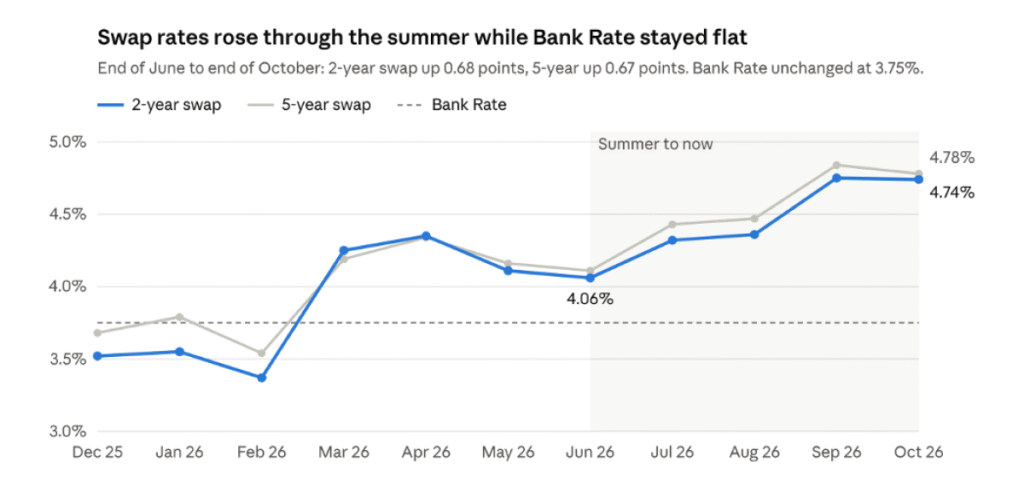
Mortgage Compare analysis of Bank of England data (CC BY 4.0) | month-end SONIA swap rates, December 2025 to October 2026 (October to 30 Oct).
Bank Rate has been 3.75% since 18 December 2025. Over the same period the two-year swap has risen by about 1.2 points and the five-year by about 1.1. A one-month view hides most of that: the bulk of the summer’s rise came in a single jump in September, after a dip in May and June that left many landlords working from cheaper figures.
Lenders don’t pass every move straight through, because pricing also reflects competition and margins. But if Landlord B’s stress rate had risen by the same 0.68 points as the two-year swap, from 7.5% to 8.18%, the maximum loan on the same £1,200 rent would fall from £153,600 to about £140,800. That is nearly £12,800 less on the same property, with Bank Rate unchanged throughout.
“The calls I am getting this month are not from people buying. They are from landlords coming to the end of a fix who assumed the loan would simply roll over, and are now being told the rent supports less than they owe. Nothing about the property has changed. The test has, and the time to find that out is three or four months before the deal ends, not three or four weeks.”
Where lenders differ, and where deals go wrong
Criteria vary by lender and by your own circumstances, so what follows describes common patterns rather than what any one lender will do.
Tax status. On a personal-name application, the biggest single swing is whether you are a higher-rate taxpayer. Many lenders will ask for your SA302 and Tax Year Overview to confirm you are a basic-rate taxpayer before applying 125%. If you are close to the higher-rate threshold, or the rental income will take you over it, find out which approach a lender takes before you choose it, not after.
Limited companies. A property held in a limited company, usually a special purpose vehicle (SPV, a company set up only to hold and let property), is commonly tested at 125% whatever the director’s personal tax position, because the company pays corporation tax on profit after interest. That is a lending advantage, and it is one reason the limited company question comes up so often for higher-rate taxpayers. Whether a company suits you is an accountant’s question before it is a mortgage one, and the lending advantage on its own should not decide it.
Five-year fixed rates. Because the lender can test at the pay rate, a five-year fix will often produce the largest loan, sometimes by a wide margin. The trade-off is being tied in, with early repayment charges that can run to several percent of the balance in the early years. On a property you mean to hold for five years anyway, that is usually a fair trade. On one you might sell or refinance in two, it may not be.
Top slicing. Where the rent falls short, some lenders will let you cover the gap from personal income, which the market calls top slicing. Each lender sets its own rules on how much income counts and the minimum it wants to see, and some will not do it at all. It can rescue a deal that is a little short. It will not rescue one that is a long way short, and it ties your own affordability into the application in a way a pure rental calculation does not.
Portfolio landlords. If you have four or more mortgaged buy-to-let properties, the PRA expects the lender to look at the whole portfolio, not just the property being bought or refinanced. In practice that means a portfolio-level stress test on top of the one for the new loan, and a weak property elsewhere can hold back a strong one. Landlords buying their fourth property are often surprised that the lender wants a schedule of the other three.
HMOs and multi-unit blocks. A house in multiple occupation (HMO) is let room by room, so its total rent is higher than the same house let whole. Some lenders will test on the full room rent. Others will only use the figure their valuer gives for the house let as a single unit, which can be far lower. That choice is set by the lender’s policy, not the valuer on the day, and it can decide whether the deal works.
Remortgaging without new borrowing. A product transfer with your existing lender, where the loan amount does not change, is often not put through the full affordability test again. When the test has tightened, that can be the difference between keeping your current loan and being asked to reduce it. Whether a transfer beats a full remortgage is a separate question, and the answer changes with pricing.
Why Choose Visionary Finance
Visionary Finance is an FCA regulated mortgage broker based in Milton Keynes, working with landlords across the UK and overseas. We specialise in buy-to-let, limited company and HMO lending, expat mortgages, remortgaging and self-employed clients, and we place cases with mainstream and specialist lenders. Before an application goes anywhere we run the stress test across the lenders whose criteria fit the case, so you know what the rent will actually support before you commit to a purchase. The first conversation carries no obligation.
Get in Touch
Email: [email protected]
Call: 01908 465 100
Start a WhatsApp conversation

Important information
This guide is general information and is not advice. It does not take account of your circumstances and should not be relied on as a recommendation. Tax content is general information only and not tax advice, and tax treatment depends on individual circumstances and may change. You should take advice from a qualified accountant or solicitor on tax and legal matters. The Financial Conduct Authority does not regulate most buy to let mortgages. Your property may be repossessed if you do not keep up repayments on your mortgage.
Sources:
- Mortgage Compare analysis of Bank of England data, swap rates (month-end figures, curve date 30 October 2026). Contains Bank of England data, CC BY 4.0. Credit as shown is required.
- Bank of England, SS13/16 Underwriting standards for buy-to-let mortgage contracts.
- Bank of England, CP11/16 (5.5% minimum, five-year horizon, five-year fixed exception).